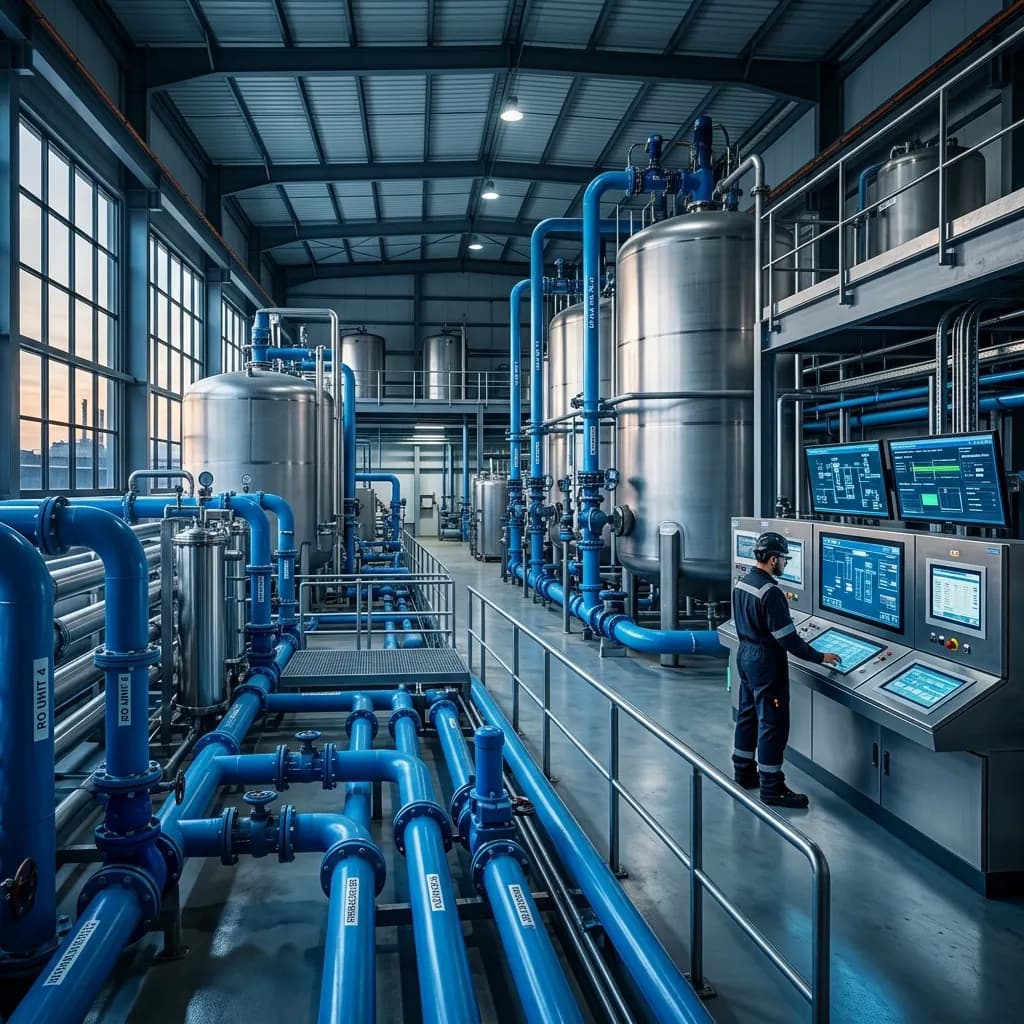
Effluent Treatment Plant (ETP) Solutions in Bangladesh
Design, manufacture, installation and commissioning of ETPs that hold Department of Environment discharge limits under real production load.
An Effluent Treatment Plant treats the wastewater a factory's process generates, bringing colour, chemical oxygen demand, suspended solids and pH inside the discharge limits set by the Department of Environment before the effluent leaves the site. Getting that right is a design problem before it is an equipment problem: the same nominal capacity can pass or fail depending on how well the process train matches the effluent's actual load.
WTBL designs each ETP around a characterisation of the client's own effluent rather than a catalogue configuration, then manufactures the core equipment — clarifiers, DAF units, mechanical screeners, sand filters and pressure vessels — at its own Gazipur factory. Building locally keeps quality control in-house and takes the longest import lead times off the project's critical path.
How a ETP plant works.
- 01
Screening and equalisation
Coarse and fine screens remove rags, lint and solids that would damage downstream pumps. The equalisation tank then buffers the sharp swings in flow, temperature and pH that batch processes produce, so the biological stage sees a steady load instead of a series of shocks.
- 02
Chemical treatment and primary clarification
Coagulant and flocculant dosing destabilises colloidal colour and suspended matter so it can be separated, either by dissolved air flotation for light flocs or by primary clarification for heavy ones. Correct dosing here removes a large share of the load before it ever reaches the biology.
- 03
Biological treatment
Aerobic biological treatment — activated sludge, MBBR or MBR depending on footprint and effluent target — converts dissolved organic load into biomass. Aeration is the largest single operating cost in most ETPs, which is why blower selection and dissolved-oxygen control get disproportionate design attention.
- 04
Secondary clarification and tertiary polishing
The secondary clarifier separates biomass from treated water and returns sludge to keep the biological stage stable. Where the discharge limit or a reuse target demands more, tertiary filtration, activated carbon or membrane polishing follows.
- 05
Sludge handling and dewatering
Sludge is thickened and dewatered by filter press, belt press or screw press into a cake that can be handled and disposed of legally. Under-specified dewatering is one of the most common reasons an otherwise sound ETP becomes unmanageable in operation.
Scope of supply.
Effluent characterisation and process design
Sampling and analysis of the actual effluent, followed by a process design and mass balance sized to the plant's real load and its growth plan — not to a nominal m³/day figure alone.
In-house manufacturing
Clarifiers, DAF units, mechanical screeners, sand filters, pressure vessels and skids are fabricated at WTBL's own factory in Kaliganj, Gazipur, which shortens delivery and keeps spare-part supply local.
Installation and commissioning
Mechanical and electrical installation, control panel integration, biological seeding and performance testing through to the point where the plant demonstrably meets its discharge parameters.
Compliance documentation
Design data, performance guarantees and test results prepared in the form the Department of Environment and, for economic zone sites, BEZA expect to see.
Operation, maintenance and upgrades
O&M contracts, chemical supply, operator training and retrofits — including capacity upgrades and compliance remediation for existing plants that WTBL did not originally build.
Where ETP systems are used.
- Textile dyeing, washing and printing
- Pharmaceuticals
- Pulp and paper
- Food and beverage
- Cement and steel
- Economic zones and industrial parks
Talk to an engineer, not a form
Every plant is sized from the client's own effluent or feed water analysis. Send your figures and WTBL will come back with a process route and an indicative scope.
Contact WTBLTechnical documents
ETP — Frequently Asked Questions
Straight answers to the questions buyers ask most often before commissioning a ETP system.
What is an Effluent Treatment Plant (ETP)?
An ETP treats industrial wastewater — the effluent produced by a factory's process — so it meets legal discharge standards before it leaves the site. A typical ETP combines physical screening, chemical coagulation, biological treatment and sludge dewatering, with the exact process train chosen to match the effluent's load and chemistry.
How much does an ETP cost in Bangladesh?
ETP cost is driven by hydraulic capacity (m³/day), the effluent's pollutant load, the treatment technology required to meet the discharge limit, and how much civil work the site needs. Because those four variables differ enormously between a knit dyeing unit and a pharmaceutical plant, WTBL quotes only after an effluent characterisation and a site survey rather than publishing a price list.
What is the difference between an ETP and a CETP?
An ETP treats the effluent of a single factory and sits inside that factory's boundary. A CETP — Central or Common Effluent Treatment Plant — is a shared plant serving many factories in an industrial park or economic zone, with each member unit sending effluent through a common collection network. CETPs achieve lower per-unit cost but require the members' effluent to be chemically compatible.
How long does it take to build an ETP?
A typical industrial ETP takes several months from design freeze to commissioning, with the timeline dominated by civil construction and equipment lead time rather than installation. WTBL's in-house manufacturing of clarifiers, DAF units, screeners and pressure vessels removes the longest import lead times from the critical path.
Can an existing ETP be upgraded instead of replaced?
Usually yes. Where an existing plant is undersized, failing its discharge limits, or needs to support increased production, WTBL retrofits additional treatment stages, replaces aeration or dewatering equipment, or adds tertiary polishing rather than rebuilding from scratch. An audit of the existing plant's performance determines which route is cheaper.