ETP vs CETP vs ZLD: Which Does Your Factory Actually Need?
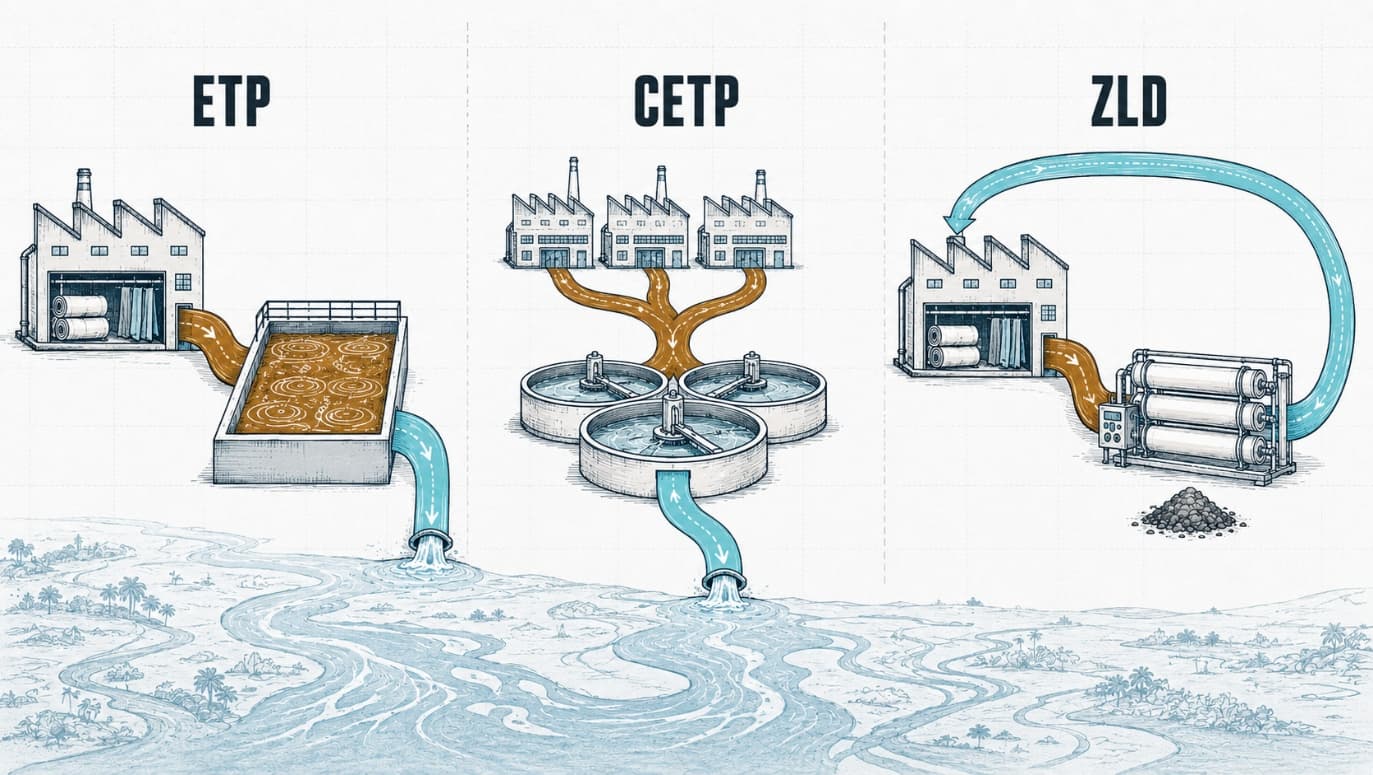
A practical guide for Bangladeshi manufacturers, with international benchmarks
Water Technology BD | Industrial Water Solutions

Every week we get some version of the same call. A dyeing mill in Gazipur has been served a notice. A washing plant in Narayanganj has a buyer audit in six weeks. A tannery has been told its ClearStream report failed. An API manufacturer has been asked by an overseas customer to evidence its antibiotic discharge concentrations. And the question is always framed the same way:
"Should we build an ETP, connect to a CETP, or go for ZLD?"
It's the right question asked in the wrong order. ETP, CETP and ZLD are not three competing products on a shelf. They are three different answers to three different problems: regulatory discharge, shared infrastructure, and water recovery. Choosing between them without first knowing which problem you actually have is how factories end up with a Tk 8-crore plant that still fails a color test, or a recovery train running at half its rated recovery because the supplier quoted equipment instead of designing an outcome.
This article lays out what each option really is, what Bangladeshi law now demands, what your buyers demand on top of that, how India, the EU and China have handled the same decision, and a decision framework you can run against your own site this week.
1. The three options, stated plainly
ETP (Effluent Treatment Plant). A treatment plant you own and operate, inside your own boundary, sized to your own flow. Output goes to a permitted discharge point: a drain, canal or river. A typical textile ETP in Bangladesh is a physico-chemical + biological train: screening and equalization, cooling, neutralisation, coagulation–flocculation, primary clarification, aeration (activated sludge, MBBR or SBR), secondary clarification, sometimes tertiary polishing with sand/carbon filtration or ozone for color, then sludge thickening and dewatering.

CETP (Central/Common Effluent Treatment Plant). One large plant serving many factories in a cluster, estate or economic zone. Members pre-treat in-house to an agreed inlet specification, then pipe effluent to the shared plant. Capital and operating cost are pooled.

ZLD (Zero Liquid Discharge). Not a plant type but an outcome: no liquid effluent leaves the site at all. Everything is recovered as reusable water plus solid residue. It is your ETP plus a recovery train: typically ultrafiltration, reverse osmosis (often two passes), then thermal concentration via multi-effect evaporator or mechanical vapor recompression, and finally a crystallizer or dryer to turn the last brine into salt cake.


2. What Bangladeshi law now requires
This is where the decision starts, because it is the only part that can shut your gas and electricity off.
The Environment Conservation Rules 2023 (ECR 2023), effective 5 March 2023, replaced ECR 1997 and materially raised the bar for wet-processing industries. Three shifts matter most:
The numbers got harder. For textile effluent, the BOD limit was cut to 30 mg/L, COD sits at 200 mg/L, pH must fall between 6 and 9, discharge temperature must be within 5°C of the receiving water body, and, for the first time, there is an explicit color limit of 150 Hazen (Pt-Co) plus caps on specific dye and pigment components. If you built your ETP against ECR 1997 assumptions, your biological stage may be adequate while your color performance is not. Color and residual COD are the two parameters most Bangladeshi ETPs fail on today, and both usually need a tertiary step that older plants simply do not have.
Monitoring became the compliance test. Under ECR 2023 and the Department of Environment's enforcement approach, having an ETP is no longer the point; proving it works continuously is. Discharge must happen through defined, monitorable outfall points. Where effluent goes to surface or inland water, the entrepreneur is expected to install, at their own cost, flow meters, automatic samplers and continuous monitoring equipment. Your ETP design and your ETP manpower structure (named, qualified technical staff, not a general maintenance hand) are submitted to and approved by the DoE.
The enforcement teeth are real. The Director General holds statutory power to order renovation, alteration or replacement of ETP machinery where performance drops. Operating without valid clearance or in breach of monitoring conditions can lead to disconnection of commercial electricity, gas and water; unpaid environmental compensation can suspend or cancel licenses.
The practical implication: in Bangladesh, ETP is not one of three choices. For a standalone factory, a properly sized, properly instrumented, properly staffed ETP is the floor. CETP and ZLD are decisions layered on top of that floor, not substitutes for it.
If your plant was built before 2023, this is a retrofit question
Most ETPs operating in Bangladesh today were designed against ECR 1997 numbers. They are not bad plants; they were built to a different specification. Bringing one up to current limits is usually an upgrade rather than a replacement, and it is the most common work we are called in to do.
A color and residual COD retrofit typically involves some combination of coagulant and flocculant re-optimization with jar testing against your actual dye chemistry, a tertiary polishing stage such as ozonation, activated carbon or advanced oxidation sized to your real hydraulic peak rather than your nameplate flow, dosing automation to replace manual control, and additional equalization volume where batch discharges are shocking the biology. Where the existing aeration stage is sound, that stage stays.
The second half of the retrofit is instrumentation. ECR 2023 expects flow meters, automatic samplers and continuous monitoring at the outfall, installed at the factory's cost. This is worth treating as an asset rather than a levy: the same instruments that satisfy the DoE also tell you when dosing is drifting, when a stage is failing, and whether you are paying for chemicals you do not need. Plants with real online data run cheaper than plants without it. We supply, install and integrate this alongside the process work, and we prepare the ETP design and manpower documentation that goes to the DoE for approval.
3. What your buyers require on top of the law
National limits are the minimum. Your commercial license to operate is written by your customers.
ZDHC Wastewater Guidelines are the de facto global standard for textile, apparel, leather and footwear. Version 2.2 has governed Gateway reporting since November 2024 (reports uploaded from 1 December 2024 must use it). Three points are commonly misunderstood on the factory floor:
ZDHC works in three tiers: Foundational, Progressive, Aspirational, not pass/fail. A brand may contractually require Progressive even where Foundational is met.
It covers conventional parameters, anions, heavy metals and MRSL substances in both wastewater and sludge, with sludge disposal pathways ranked from high-temperature incineration and engineered landfill down to uncontrolled dumping. A factory can pass on water and fail on where its sludge goes.
Testing is twice yearly, with cycles due before 30 April and 31 October. ZDHC is not law in any country, but failing it can cost you an order faster than a DoE notice.
For leather, Leather Working Group (LWG) audit outcomes hinge substantially on effluent management, and this is where Bangladesh's most expensive infrastructure lesson sits (Section 6).
For pharmaceuticals, the equivalent instrument is the AMR Industry Alliance Antibiotic Manufacturing Standard, facilitated by BSI. Launched in 2022 and updated in May 2025 to align with the WHO's 2024 guidance on responsible antibiotic manufacturing, it is the only independently certifiable standard for responsible antibiotic production, and it carries stricter waste management rules, API discharge limits and supply chain transparency requirements. Certification is delivered as a BSI Kitemark; more than 60 antibiotic products have been certified across 15 geographies, and the revised Standard rolled into certification from early 2026. Critically for contract manufacturers, the scheme is already embedded in healthcare procurement, including the NHS antibiotic subscription model, so it functions as a market access requirement rather than a badge. Its core test is described in Section 5.
There is also a growing water-quantity expectation that has nothing to do with discharge quality. BGMEA is working with the World Bank on a National Water Reuse Strategy targeting a 50% reduction in the sector's blue water footprint by 2030. The Alliance for Water Reuse and Recycling, convened with the World Bank Group's 2030 Water Resources Group, aims to cut wastewater generation in the Greater Dhaka watershed by 20% by reusing and recycling roughly 350 million m³ a year. Brands are already co-investing: a public-private upgrade at Fakir Knitwears, backed by UNCTAD's SMEP program alongside Primark, H&M, WaterAid, Grundfos and others, represents about US$1.7 million and enables the reuse of roughly 438,000 m³ of treated water annually, more than 22% of the factory's effluent, with 25% as the next milestone.
Read that carefully, because of the direction it points. Buyers began by asking for compliant discharge, then for a reuse percentage, and the percentages only move one way. A reuse target is not an alternative to zero; it is the first instalment of it. A factory that builds a 25% reuse train with no route to 50 or 70 will be buying the same asset twice. The commercially sensible move is to design the endpoint now and install it in stages, which is exactly what Section 7 sets out.
4. International practice: what four jurisdictions actually did
India: the ZLD mandate, and its bill
India is the closest and most instructive comparison. In Tirupur, Tamil Nadu, decades of dyeing effluent into the seasonal Noyyal river produced court intervention rather than gradual regulation: Supreme Court and Madras High Court orders culminating around 2010–2011 in closure of hundreds of dyeing and bleaching units and an effective requirement that they reopen only on zero liquid discharge, verified by the state pollution control board. The industry rebuilt around 18 CETPs plus individual plants, and ZLD trains there now demonstrate recovery of roughly 92–95% of water with salt recovered back into dyeing.
Today, ZLD is mandatory for textile dyeing and processing in Tamil Nadu and Gujarat and for tanneries in Vellore, with RO plus multi-effect evaporation plus crystallisation as the expected configuration.
The same pattern repeated in pharmaceuticals. Bulk drug clusters at Patancheru-Bollaram in Telangana, Baddi in Himachal Pradesh and Cuddalore in Tamil Nadu became national pollution cases, with litigation running from 1990 through the Supreme Court to the National Green Tribunal. Sampling around Hyderabad found antimicrobials in every one of 28 sites tested, at concentrations linked in peer-reviewed work to the spread of multi-drug-resistant bacteria. The regulatory response was the same instrument: Indian pharmaceutical units are now required to operate ETPs and adopt ZLD, backed by CPCB effluent standards for the sector covering TDS, COD and biological contaminants, with loss of manufacturing license as the sanction. In Telangana, large pharmaceutical manufacturers run ZLD and are simply not permitted to discharge.
Three lessons Bangladeshi mill owners should take from Tirupur:
ZLD was imposed because the receiving river had no assimilative capacity, a seasonal river with no dilution. It was a hydrological verdict, not a technology preference.
It worked technically. What hurt was the sequence. Tirupur's units retrofitted ZLD under closure orders, on a court timetable, with no opportunity to segregate streams first, reduce specific water consumption first, or integrate the thermal duty into their utilities. That is the most expensive possible way to arrive at zero, and it is why capex, opex and footprint are all documented as painful there. The units that came through it best had solved their energy side, in their case with wind power on the grid. Bangladeshi factories still have the one advantage Tirupur lost: time to design it in the right order.
It did not fully clean the river. Reporting a decade on found the Noyyal still degraded, because dyeing units were never the only source. ZLD at your gate does not fix a watershed on its own, which is exactly why cluster-level and watershed-level approaches matter.
The EU: regulate the process, not just the pipe
The EU took the opposite route. Under the Industrial Emissions Directive (2010/75/EU), the BAT conclusions for the Textiles Industry were adopted in December 2022 and became the binding reference for permit conditions, covering wet pretreatment and dyeing installations above 10 tons/day.
The EU does not mandate ZLD. Instead it sets BAT-associated emission levels. For direct discharge, COD falls in the range of roughly 40–100 mg/L (with a higher ceiling under defined conditions), with total organic carbon preferred as the monitoring parameter. Those levels are paired with chemical substitution requirements, chemicals management, an effluent toxicity parameter, and water reuse as a named technique.
The single most important number in that framework for a Bangladeshi factory is not a concentration limit at all. It is the condition tied to specific wastewater discharged of less than 25 m³ per ton of treated textile material: that is, 25 liters per kilogram.
Compare: IFC's Partnership for Cleaner Textile estimates Bangladesh's wet-processing sector consumes around 1,500 billion liters of water a year to process about 5 million tons of fabric, roughly 300 liters per kilogram. Detailed factory surveys put average groundwater use nearer 164 L/kg and dyehouse water around 136 L/kg, with wastewater around 119 L/kg. International good practice sits closer to 50 L/kg.

A factory at 250 L/kg is buying every downstream asset at roughly four times the size it needs. Every liter you don't use is a liter you don't heat, don't dose, don't treat and don't evaporate. Halving specific water consumption halves your hydraulic load, which halves the tank volumes, the aeration duty, the membrane area and, most expensively of all, the evaporator. PaCT's record shows the scale available: over a decade it engaged more than 450 factories and catalyzed on the order of 35 billion liters of freshwater savings and 29 billion liters of wastewater reduction annually.
This is why efficiency is the first line item in our scope rather than an alternative to it. Counterflow rinsing, reduced liquor ratios, bath and condensate reuse, right-first-time dyeing to cut reprocessing, and cooling water recovery are not a substitute for building the plant. They are how you avoid overpaying for the plant, and they are the difference between a ZLD business case that clears an investment committee and one that does not.
China: quotas and caps
China's approach in stressed basins has combined discharge standards with water-use quotas, industrial park consolidation into shared treatment, and pollutant load caps by basin rather than by factory. The structural lesson is the same as the EU's: allocate the resource, then let facilities choose the technology that meets the allocation.
5. Pharmaceuticals: the same three options, a very different problem
Almost everything written about ETPs in Bangladesh is written about textiles. That is a problem, because the country's second great export manufacturing story runs on completely different effluent, and a pharmaceutical plant that buys a textile-specification ETP will fail.
Why pharmaceutical effluent breaks a conventional ETP
Five characteristics separate it from dyehouse wastewater:
It is not continuous. Formulation and API plants run in batches and campaigns. Flow arrives in slugs, and composition changes completely when the campaign changes. An ETP sized on daily averages will be hydraulically overwhelmed on discharge days and starved of feed in between, which is how biomass dies. Equalization volume is not a detail here; it is the design.
It resists biology. Pharmaceutical effluent typically shows a poor BOD to COD ratio, meaning much of the organic load is not readily biodegradable. Solvent residues, intermediates and recalcitrant molecules pass straight through an activated sludge plant that would handle textile load comfortably.
It is actively toxic to the treatment plant itself. Antibiotics, disinfectants, preservatives and cytotoxic compounds inhibit or kill the very micro-organisms the ETP depends on. Sending an antibiotic-bearing stream to a biological reactor is not treatment; it is sterilization of your own asset.
The discharge target is not just a concentration, it is a residue. Color and BOD are not the parameters that will end a pharmaceutical company's export relationship. Antibiotic residues are.
The high-risk streams are small. Mother liquors, solvent washes, equipment cleaning water from potent product lines and cytotoxic or hormone streams are often a small fraction of total volume while carrying most of the risk and most of the load.
That last point is the good news, and it drives the correct design philosophy: segregate at source, treat the nasty streams separately and hard, and send only the benign bulk to biology. In practice that means dedicated collection for potent, cytotoxic and antibiotic streams, solvent recovery or stripping where economic, chemical oxidation or Fenton treatment for recalcitrant COD, activated carbon polishing, and thermal destruction or licensed incineration for concentrates that must not be discharged at all. Membrane bioreactors are frequently the right core technology for pharmaceutical sites because they retain biomass independently of settling and tolerate the variability that batch production imposes.
What Bangladesh actually requires of pharmaceutical plants
Pharmaceutical manufacturing sits in the most heavily regulated environmental category under ECR 2023, and the general obligations described in Section 2 apply in full: approved ETP design, approved qualified ETP manpower, monitored outfalls, and the Director General's power to order plant replacement where performance drops.
Layered on top is the Drugs and Cosmetics Act 2023, which widened the approvals a manufacturer needs beyond a DGDA licence. API producers now also need clearances from the Department of Narcotics, the Department of Explosives and the Ministry of Commerce before commissioning. The practical consequence for water and effluent planning is scheduling: environmental infrastructure now sits on a critical path with several agencies on it, and a plant that treats the ETP as a post-commissioning item will delay its own production start.
There is also the export dimension. Bangladesh exports medicines to a large number of countries, and WHO GMP, EU GMP and US FDA site inspections increasingly look at environmental management as part of overall site control rather than as someone else's department.
The API Park: Bangladesh's second CETP lesson, unfolding now
The Active Pharmaceutical Ingredients Industrial Park at Gazaria in Munshiganj was built by BSCIC on 200 acres with 42 plots for 21 industrial facilities, and a Common Effluent Treatment Plant plus a waste dumping yard were part of the offer from the start. BAPI members were to finance the CETP, and construction was awarded to India's Ramky Environment Services.
The park has taken shape slowly. Commercial production was scheduled for one April and had not begun, with the site still awaiting a national gas grid connection and a functional common effluent plant. ACME Laboratories, Healthcare Pharmaceuticals, Ibn Sina and Unimed-UniHealth have established facilities there, and the CETP has been reported as held up by the absence of gas. Meanwhile Bangladesh still imports around 85 percent of its small molecule API requirement, at a cost near US$1.3 billion a year, and LDC graduation puts a clock on the patent flexibilities the sector has relied on.
The parallel with Savar is exact, and it is the reason to raise it here rather than let pharmaceutical clients assume the tannery story is somebody else's. Shared effluent infrastructure fails for shared-infrastructure reasons: utilities, governance, financing and operator capability, not chemistry. If you hold a plot in the API Park, the questions in Section 6 are your questions. Specifically: what is the CETP's inlet specification for solvent load and antibiotic residues, who operates it, what happens to your DGDA and export position if it is unavailable on the day you need to discharge, and what interim in-house treatment do you hold as a contingency?
The defensible position for a pharmaceutical plot holder is not "the park will provide." It is a full in-house pre-treatment capability with segregated high-risk streams, sized so that the CETP receives only what it was designed to receive, and so that a CETP outage is an inconvenience rather than a production stop.
The AMR standard changes the ZLD calculation
For antibiotic manufacturers specifically, the international requirement is now quantitative in a way no Bangladeshi rule yet is. Under the AMR Industry Alliance Standard, the antibiotic concentration at the discharge point must fall below the predicted no-effect concentration (PNEC) for that molecule. PNECs have been published for at least 125 antibiotics and are updated annually, with a default of 0.05 micrograms per liter for anything unlisted. One of the standard's own advisors likened the permitted concentration to a sugar cube in an Olympic swimming pool.
Read that number against a conventional ETP's capabilities and the conclusion is immediate. Sites are expected to demonstrate compliance through mass balance, sampling and analysis, or zero liquid discharge. For an antibiotic API line, ZLD is not the expensive option you defer; it is frequently the only defensible answer, because it removes the discharge point that the PNEC test applies to. That is a materially different verdict from the one this article reaches for textiles, and the reason is worth stating plainly: textile ZLD is usually driven by water scarcity, while pharmaceutical ZLD is driven by residue risk. Scarcity has cheaper partial solutions. Residue risk often does not.
The practical implication is that segregation pays twice for pharmaceutical sites. Confining ZLD to the antibiotic and potent-product streams, rather than applying it to the whole site, keeps the evaporator small, the energy bill survivable and the certification defensible.
And a water-quality problem textiles never have
One thing pharmaceutical clients raise that textile clients rarely do: the incoming water matters as much as the outgoing. Purified Water and Water for Injection systems to USP or Ph. Eur. specification, with the associated pretreatment, RO and EDI or distillation trains, sanitization regimes, loop design, and validation documentation, are a GMP obligation, not an efficiency project. A pharmaceutical water strategy that addresses effluent without addressing process water generation, storage and distribution is only half a strategy, and the two systems compete for the same site utilities, the same footprint and the same capital budget. They should be planned together, by one party, with one set of drawings.
That is how we scope pharmaceutical sites: generation and distribution on the clean side, segregation and treatment on the effluent side, and the utility and footprint interactions between them resolved once rather than twice. It also means the reject from your purified water RO is accounted for as a stream rather than discovered later as a problem, and that validation and qualification documentation is produced alongside the equipment rather than assembled afterwards.
6. The Bangladeshi cautionary tale every CETP conversation needs
If a shared plant sounds like the cheap way out, study Savar.
The Savar Tannery Industrial Estate CETP at Hemayetpur was approved in January 2003 for completion by December 2005 at about Tk 175 crore. It was declared complete in June 2021, some 18 and a half years later, with actual spending near Tk 937 crore. Design capacity is around 25,000 m³/day, against post-Eid-ul-Azha peaks reported as high as 50,000 m³/day.
Years on, government's own Implementation Monitoring and Evaluation Division has found the CETP and waste management facilities still not functioning at the expected level, citing excess flow, higher chemical and water use by tanners, solid waste entering the CETP line, power shortages, weak operation and maintenance, and a shortage of skilled manpower. The Dhaleshwari now carries what the Buriganga once did.
The commercial consequence is the part to internalize. Because the estate's effluent management is not up to standard, tanneries inside it have struggled to obtain LWG certification, while compliant units outside the estate have not been similarly handicapped. Industry representatives have described export realizations falling from around US$1.50–2.00 per square foot to 40–50 cents, with buyers redirected and volumes sold into lower-value markets. Economists and sector bodies are now calling for the plant to stay in public ownership but be handed to a competent professional operator.
The lesson is not "never join a CETP." Well-run common plants are the correct answer for small and medium units that cannot each afford a compliant plant, and they are standard practice from Tirupur to Pali to European industrial parks. The lesson is that a CETP transfers your compliance risk to a third party. Before you connect, you need answers on paper: Who operates it, with what qualifications? What is the guaranteed inlet specification and outlet performance? What is the hydraulic and load headroom at peak season? What happens to your clearance and your buyer audit when the shared plant fails? What is the tariff escalation mechanism? Is there a chrome recovery unit and a lawful solid-waste route?
And regardless of the answer: keep your own screening, flow equalization, cooling, neutralisation and, for tanneries, chrome recovery in-house. Never send a shared plant a shock load and expect it to absorb your process variability.
This is a defined scope rather than a vague recommendation, and it is one of the more cost-effective packages we build: a compact in-house pre-treatment train sized to the CETP's contractual inlet specification, with enough buffer volume that your discharge profile is smooth regardless of what your production floor does. Chrome recovery in particular pays for itself in recovered chrome as well as in audit position. Specified properly, the same train is also the foundation you would build on if you later decide to treat and reuse in-house rather than remain dependent on the shared plant, which is the direction several estate tenants are now moving for exactly the reasons this section describes.
7. Making ZLD deliver: what separates a working plant from a stranded asset
ZLD is the most capable thing you can build, and for a growing set of Bangladeshi factories it is the only answer that holds up over a twenty-year horizon. It is also the option most often sold badly, by suppliers who quote a membrane skid and leave the client to discover the rest. Both things are true at once, and the difference between them is engineering.
Start with what ZLD actually buys you
The compliance argument is the obvious one, and it is the weakest. The stronger case is commercial.
It removes your outfall, and with it your entire discharge risk. No outfall means no color test, no COD exceedance, no environmental compensation exposure, and no vulnerability to the next revision of ECR. Bangladesh's limits have tightened once already, with color caps and continuous monitoring arriving where neither existed before. A factory that discharges is permanently exposed to the next tightening. A factory that does not, is not. For a plant with a twenty-year asset life, that is the difference between one capital decision and three.
It makes production independent of your borewell. Groundwater yields across Dhaka, Gazipur, Savar and Narayanganj are falling and abstraction licensing is tightening. Every factory relying on a single deep tubewell is running an unhedged operational risk on its most basic input. Recovering 90 percent or more of your water converts that risk into a fixed asset you control, and at some Bangladeshi sites the resulting continuity value alone has justified the investment inside a year or two.
Recovered water comes back warm, and that is real money. This is the benefit most consistently left out of ZLD business cases. Reclaimed water returns at elevated temperature, so reusing it displaces steam you would otherwise burn to heat fresh water to dyeing temperature. On a dyehouse running high liquor ratios, the thermal recovery can carry a meaningful share of the plant's own operating cost. A ZLD business case built on water charges alone systematically understates the return.
Salt and chemicals become recoverable rather than disposable. Tirupur's ZLD plants recover salt back into dyeing, which is the outcome that converts your largest waste stream into an input. It requires purity, and purity requires segregation, which is precisely why segregation is an engineering decision and not an afterthought.
It satisfies the requirements your buyers are moving toward, not just the ones they hold today. ZLD is a recognised discharge type under the ZDHC framework, and for antibiotic manufacturing the AMR Industry Alliance Standard names zero liquid discharge explicitly as a route to demonstrating PNEC compliance. As Section 5 sets out, for potent and antibiotic lines it is frequently the only defensible answer, because it removes the discharge point the test applies to.
It unlocks expansion where discharge consent would cap you. If your permitted discharge volume is the constraint on adding capacity, ZLD converts a regulatory ceiling into an engineering problem you can solve.
The four questions that decide whether it pays
These are the questions a serious supplier raises before quoting, and the reason we raise them here is that each one has a design answer. None of them is a reason to walk away. Each is a reason to design properly.
1. Have you segregated before you concentrate? Salt-heavy reactive dyebath and mercerizing streams handled separately from low-TDS rinse and wash water dramatically shrinks the thermal duty, because you are only evaporating the fraction that actually carries the salt. Sending one mixed stream to RO is the most expensive way to reach any recovery target, and it is also what produces a mixed sodium sulphate and chloride residue that nobody will buy. Segregation is what makes both the energy bill and the salt revenue work, and it is the single highest-leverage decision in the whole project.
2. Where does the thermal energy come from? Evaporation is a permanent energy cost, so it should be designed against your actual utilities rather than bolted on. Mechanical vapor recompression shifts the load from steam to electricity where that arbitrage favors you. Multi-effect evaporation is more efficient per unit of steam where boiler headroom exists. Waste heat, flue gas and condensate recovery can offset a substantial share of the duty. The question is not whether ZLD uses energy but whether the design uses yours intelligently, and that is answered by a site utilities study, not a catalogue.
3. What is the endpoint for the salt and the sludge? This deserves to be settled at design stage, because it drives the crystallizer specification. Segregated streams can yield salt at a purity worth returning to your own dyehouse. Mixed residue needs a documented, licensed disposal pathway, and since both your ETP sludge and your ZLD residue require a ZDHC-recognized route, that pathway is worth establishing once, properly, for both. Designed in from the start, this is a solved problem. Discovered after commissioning, it is the thing that strands plants.
4. Who operates it, and to what availability? Membranes and evaporators are unforgiving of poor pretreatment, scaling and inconsistent dosing. Nameplate recovery is not the number that matters; sustained availability is. That means automated dosing control, online instrumentation, a defined clean-in-place regime, a properly equipped lab, trained operators, and ideally a performance-backed operations and maintenance arrangement rather than a handover and a manual.
A staged path that reaches zero without stranding capital
The most common reason a good ZLD project does not happen is that it is presented as one large decision. It does not have to be. The route we recommend reaches full ZLD through stages, each of which stands on its own and none of which is wasted:
Stage 1: a genuinely compliant ETP, with the reuse train designed in. Correct peak sizing, real equalization, automated dosing, tertiary polishing for color and residual COD, online monitoring. Critically, the layout reserves footprint, utility capacity and hydraulic connections for the stages that follow, so nothing built now has to be demolished later.
Stage 2: minimal liquid discharge, typically 60 to 70 percent recovery. UF and RO on segregated low-TDS streams, with reject to a permitted outfall. This is where the water security and thermal recovery benefits begin, on a capex figure most mills can finance from operating savings. Independent Bangladeshi cost data supports this stage strongly: the SMEP-funded pilot at Zaber & Zubair Fabrics, a modular 5 m³/hr unit combining ultrafiltration, dual-pass reverse osmosis and advanced oxidation, demonstrated recycling of up to 85 percent of textile wastewater, with operating cost for 70 percent recycling and 30 percent brine management at roughly US$0.12 to 0.30 per m³ of recycled water, and capex to scale to 100 m³/hr estimated at US$0.9 to 2 million.
Stage 3: closing the loop to zero. Thermal concentration and crystallisation on the segregated concentrate only, sized against the reduced volume that Stages 1 and 2 have already produced. This is why the sequence matters: a ZLD plant designed after segregation and efficiency work is a materially smaller and cheaper plant than one designed before.
The financing case improves at every stage, because each one lowers the water, energy and chemical baseline against which the next is measured. Brand co-investment is also actively available for this work right now, as the Fakir Knitwears programme in Section 3 demonstrates, and national policy is pushing in the same direction through the BGMEA and World Bank reuse strategy.
De-risking the decision before you commit capital. Where a board wants evidence rather than a proposal, the segregated streams can be run through a small modular recovery unit on site for a defined trial period, producing real recovery rates, real membrane fouling behavior and real concentrate volumes from your own effluent rather than from a reference plant elsewhere. That is precisely how the Zaber & Zubair figures above were generated. A pilot converts a ZLD business case from an estimate into measured data, and it is the fastest way to settle an internal argument about whether the recovery numbers hold on your chemistry.
Where we would start you at Stage 3 immediately: no lawful discharge point, an antibiotic or potent-product line subject to PNEC testing, a discharge consent that caps your expansion, or a recoverable salt stream valuable enough to pay for the crystallizer. In those cases staging is a delay, not a saving.
8. A decision framework for your site
Run these in order. The first answer that forces your hand ends the exercise.
1. Do you have a legally permitted discharge point, and does the receiving water have any assimilative capacity?
No discharge point, or a small seasonal khal, or a DoE condition specifying no discharge → you are in reuse/ZLD territory whether you like it or not. This is the Tirupur logic.
2. Are you inside an estate, EPZ or economic zone with an operating CETP?
Yes → CETP plus robust in-house pre-treatment is likely your lowest-cost entry path, subject to the due-diligence checklist in Section 6. Price the risk as well as the tariff: a shared plant you do not control sets your compliance position, your audit exposure and your cost escalation. No → an own ETP is your baseline, and most standalone Bangladeshi factories have no real CETP option anyway.
3. What is your specific water consumption, in litres per kilogram?
If you don't know, meter it before anyone sizes equipment, because this number sets the price of everything downstream. Above roughly 120–150 L/kg, efficiency work should run ahead of the plant in the same project rather than instead of it, so that what you build is sized for the factory you will be running and not the one you are running today. This is a fortnight of metering and a fortnight of analysis, not a delay to the capital program.
4. How secure is your raw water?
Deep tubewell yields around Dhaka, Gazipur, Savar and Narayanganj are falling, and abstraction licensing is tightening. If your borewell is your single point of failure, reuse becomes a business-continuity investment, not a compliance cost, with a payback that has been measured in a year or two at some Bangladeshi sites.
5. What do your buyers contractually require?
Foundational or Progressive under ZDHC? A named reuse percentage? Higg FEM scoring? Get it in writing before you specify equipment. Design to the actual requirement, not to a rumor of one.
6. What are your utilities and land actually able to support?
Spare steam, electrical capacity, and space for evaporators and covered salt handling. Treat this as a design input rather than a pass or fail: no spare steam usually points to mechanical vapor recompression instead of multi-effect evaporation, tight land points to a staged build on reserved footprint, and available waste heat or flue gas can offset a large share of the thermal duty. A utilities study answers this properly in a few weeks.
7. Is any part of your production potent, cytotoxic, hormonal or antibiotic?
For pharmaceutical sites this question outranks most of the others. If yes, segregate those streams at source before designing anything else, and assume the answer for that fraction is destruction or ZLD rather than discharge. Sizing a whole-site ZLD when only 8 percent of your flow carries the risk is the most common and most expensive mistake in this sector.
8. What is the endpoint for your sludge and salt?
Settle this at design stage, because it drives the crystallizer specification and the segregation plan. Segregated streams can yield salt clean enough to return to your own dyehouse; mixed residue needs a documented, licensed pathway. Both your ETP sludge and any ZLD residue need a ZDHC-recognized route, so it is worth establishing once, properly, for both. Designed in, this is routine. Discovered at commissioning, it is the thing that strands plants.
9. Who will operate it, and to what availability?
ECR 2023 requires approved qualified ETP manpower, and a recovery train requires more skill, not less. Trained operators, a working in-house lab, reliable dosing control and online instrumentation cost a fraction of the failure modes they prevent. If in-house capability is thin, this is solvable commercially: operator training and certification, a defined maintenance regime, or a performance-backed operations and maintenance contract where availability becomes our obligation rather than your risk. Skills gaps should not decide your technology.
9. Our recommendation: build toward zero, in the right order
For most Bangladeshi wet-processing units, full ZLD is the right destination. The question is almost never whether to get there, but how to sequence the investment so that each stage pays for the next instead of arriving as one unfinanceable number.
Meter and reduce first. Water, steam, chemicals. Target under 100 L/kg, then under 70. This is the highest-return work in the entire project, and it is what makes every subsequent stage smaller and cheaper. A factory at 250 L/kg pays roughly four times too much for the same ZLD outcome.
Build a genuinely compliant ETP, with the reuse train designed in. Correct sizing for peak flow, equalisation that actually equalises, cooling, automated dosing, tertiary polishing for colour and residual COD, online instrumentation, trained staff, and a documented sludge pathway. Reserve the footprint, utilities and connections for what comes next, so nothing built now is wasted later.
Add reuse, targeting 60 to 70 percent recovery. UF and RO on segregated low-TDS streams. This is where water security, thermal recovery and buyer scorecard benefits start paying, on a figure most mills can finance from operating savings.
Close the loop. Thermal concentration and crystallisation on the segregated concentrate only, now a fraction of the volume it would have been without steps 1 to 3. This is ZLD arrived at properly: a smaller plant, a lower energy duty, salt clean enough to have value, and no outfall left to defend against the next tightening of ECR.
Two situations where you should go straight to Stage 4. If you have no lawful discharge point, or an antibiotic, cytotoxic or hormonal line subject to PNEC testing, staging is a delay rather than a saving. For potent-product streams in particular, segregate them first and treat ZLD on that fraction as the starting assumption, because the PNEC test in Section 5 is not something a conventional plant can be optimised into meeting.
Two things to hold onto. Anyone who quotes you a ZLD plant without first asking your litres per kilogram, your salt endpoint and your spare steam capacity is selling you equipment rather than an outcome, and the plant they deliver will underperform its nameplate. Equally, anyone who tells you ZLD is simply unaffordable has not costed your water security, the heat you currently throw away, the salt you currently pay to dispose of, or the compliance retrofit you will be doing again in five years. Designed properly and sequenced properly, zero is both reachable and worth reaching.
Talk to us
Water Technology BD designs, builds, upgrades and operates industrial water and effluent systems for textile, wet-processing, leather, food, pharmaceutical and light-engineering clients across Bangladesh, from ETP retrofits for ECR 2023 colour and COD limits, to CETP pre-treatment packages, to UF/RO reuse trains and full ZLD.
We design ZLD as an outcome rather than a package: stream segregation study first, then a utilities and thermal integration plan, then a crystalliser specified against a settled salt endpoint, then instrumentation and operator training built to hold availability over the plant's life. Where a staged route makes the investment easier to finance, we design Stage 1 so that Stages 2 and 3 drop into reserved footprint without rework.
Across the rest of the scope:
ECR 2023 retrofits for existing plants, particularly colour and residual COD, including jar testing against your own dye chemistry
New ETP design and build for textile, wet processing, leather, food and pharmaceutical sites
CETP pre-treatment packages sized to a contractual inlet specification, including chrome recovery for tanneries
UF and RO reuse trains, from partial recovery through to full ZLD with thermal concentration and crystallisation
Pharmaceutical water systems, Purified Water and WFI generation, storage and distribution, planned together with the effluent side
Online monitoring and instrumentation, flow meters, automatic samplers and continuous monitoring configured for DoE requirements
On-site pilot trials using modular recovery units, so recovery rates are measured on your effluent before capital is committed
Operations, maintenance and operator training, including performance-backed O&M where you would rather availability be our obligation
Compliance documentation, ETP design and manpower submissions to the DoE, sludge pathway documentation, and evidence packs for ZDHC, LWG or AMR Standard requirements
Troubleshooting existing plants that are failing a parameter, an audit or a monitoring condition
A useful first step is small: a water and effluent audit. Specific consumption in L/kg, an inlet and outlet load profile, a stream-by-stream segregation map, a gap analysis against ECR 2023 and your buyers' ZDHC tier or AMR requirements, and a costed roadmap from where you are today to zero discharge, with the payback on each stage set out separately.
[Contact us / Request a site assessment]